
Can a Unit Study Really Work Through High School?
Yes–but only if it was designed to be a complete academic program (not just a collection of themed activities marketed as “high school level”). For many homeschoolers, “unit study” has become synonymous with “supplement” or “lighter content.” So what makes Campfire different?
Think of Each Campfire Unit Like a Textbook Chapter
Campfire feels like a unit study because it is immersive, connected, and deeply engaging.
But academically, it functions like a full curriculum built in chapter-like units.
Suppose a biology textbook has ten chapters.
One family buys the full textbook in one volume.
Another family buys all ten chapters individually.
Do they have different content?
No.
Only the binding changed.
That is similar to how Campfire units work.
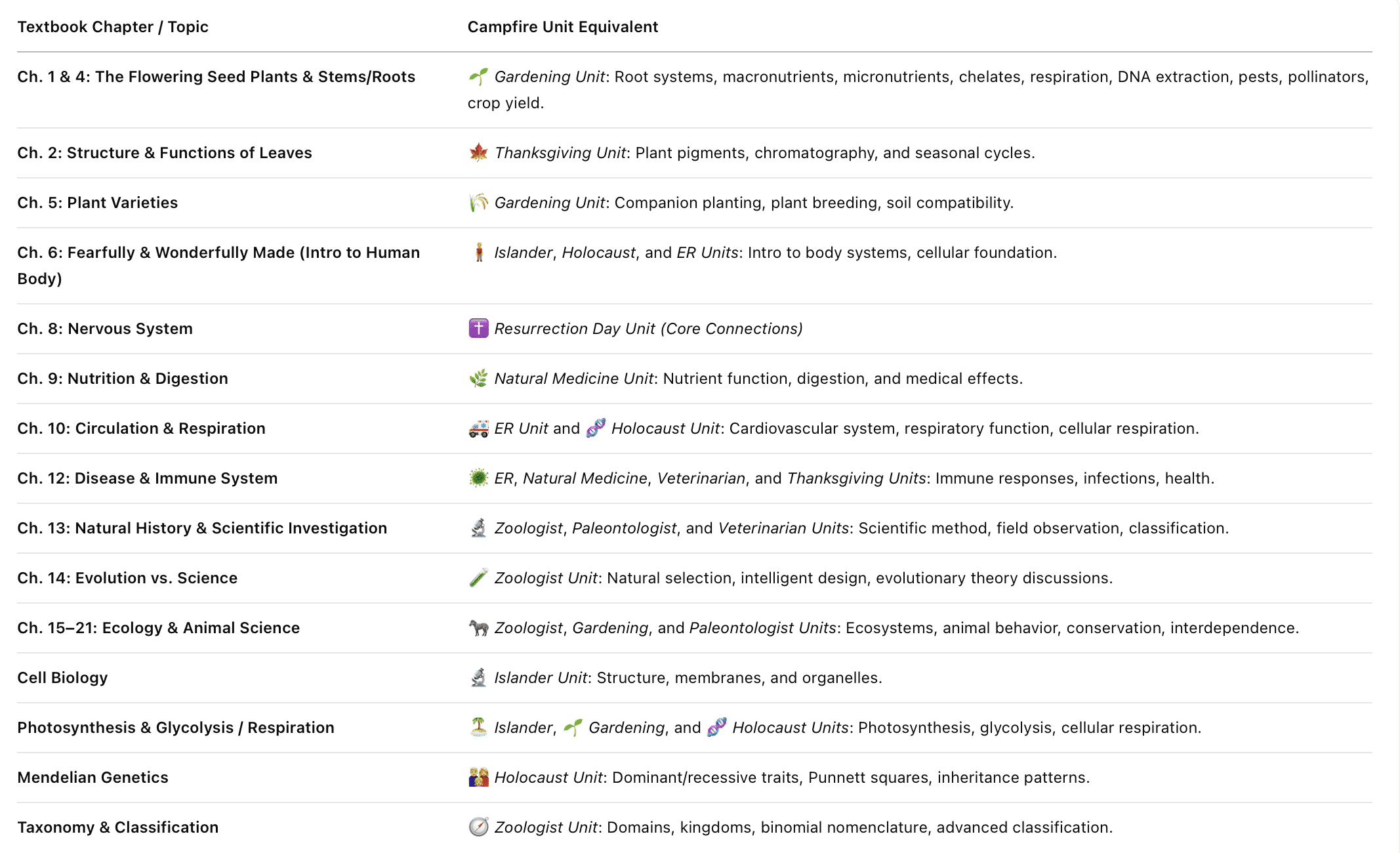
Here’s the easiest way to see the difference. Look at this side-by-side comparison of year-long textbook vs. Campfire unit coverage and see how they cover the same exact material.
Scroll left/right.
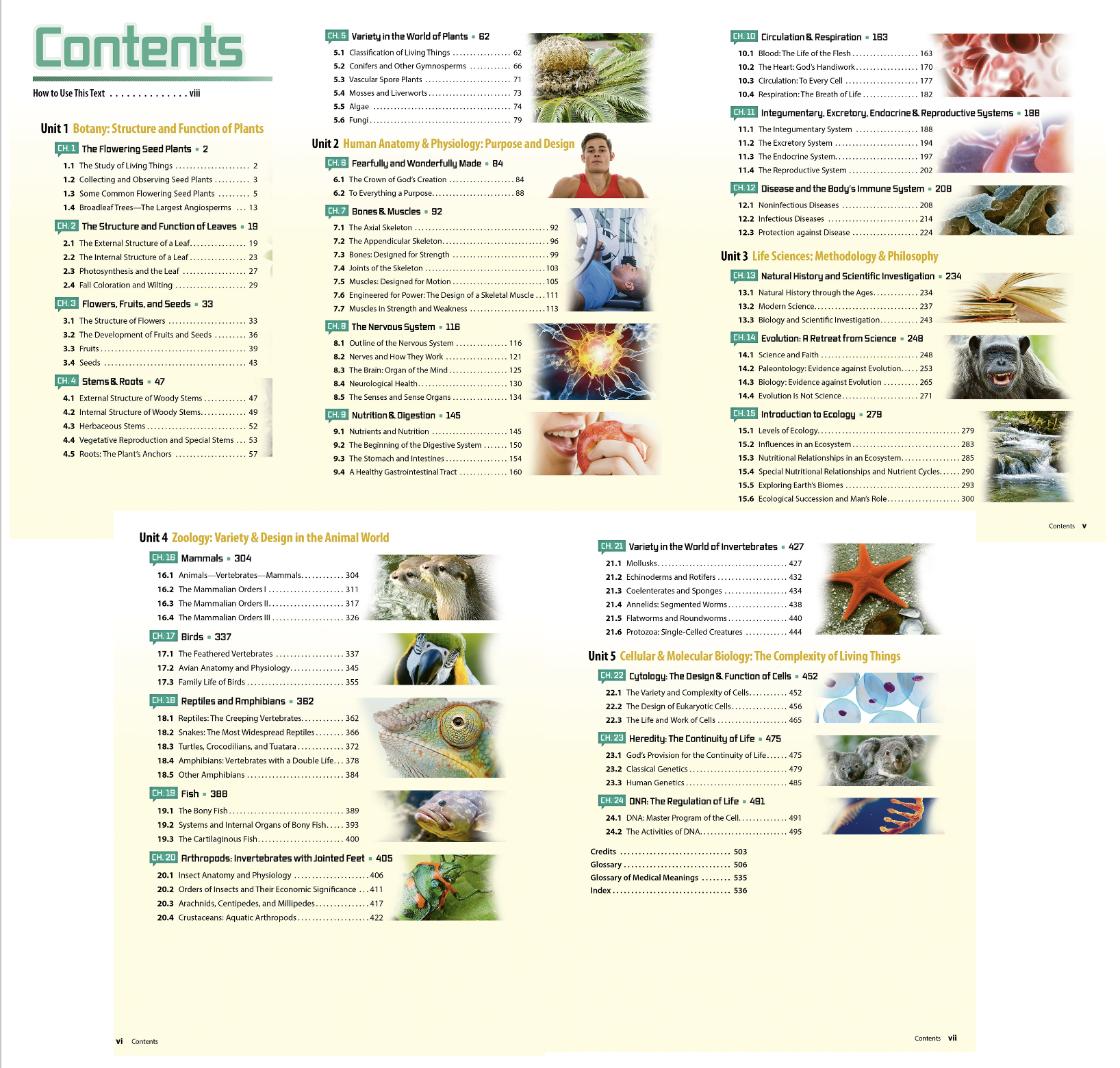
Note that the entire textbook is ~495 pages for the year, which is the same length as some of our month-long units!
“I feel like we need a degree after finishing these units. My oldest started her first year at university, and her professor called everyone’s attention to her as the example of what to do right. He literally showed her notes and held them up as the example. Campfire’s units are so deep that some of what she’s learning in university, she already learned through homeschool. Thank you, Campfire!”
“…four years of Campfire. He was accepted to college, and has held a 4.0 GPA… It works.”
“I was a music major in University and then completed my MD, …The Core Concepts which delved into the physics and biology were outstanding… I had, to date, not attempted a unit study which didn’t require a separate student manual …the single text interactive approach was liberating, creative, and extremely well suited…”
Does Not Have To Mean
Less Education
Not All Themed Studies are the Same.
Somewhere along the way, people started believing that subjects only “count” if they are disconnected.
History over here.
English and science over there.
Careers or skills in another box.
We understand because for years, that had been the norm for interdisciplinary learning. It became even more confusing when non-comprehensive programs labeled themselves as comprehensive.
To be clear, there is nothing wrong with a traditional unit study for many families, but that’s simply not what Campfire is. Most themed curricula pick a topic, then sprinkle loosely-related subjects on top as a checklist (a fun science fact, a worksheet, a craft…). Campfire is not that. Campfire starts with a full scope and sequence, then builds the themed units as the lens you see it through. It is an interdisciplinary program, shared in themed units, which is fundamentally different than traditional “unit studies.” The point isn’t whether traditional unit studies are good or bad. Every program has its place. The point is to share the flaw in labeling all themed studies the same. Comparing them side-by-side like “apples-to-apples” is a disservice to both. Here’s why…
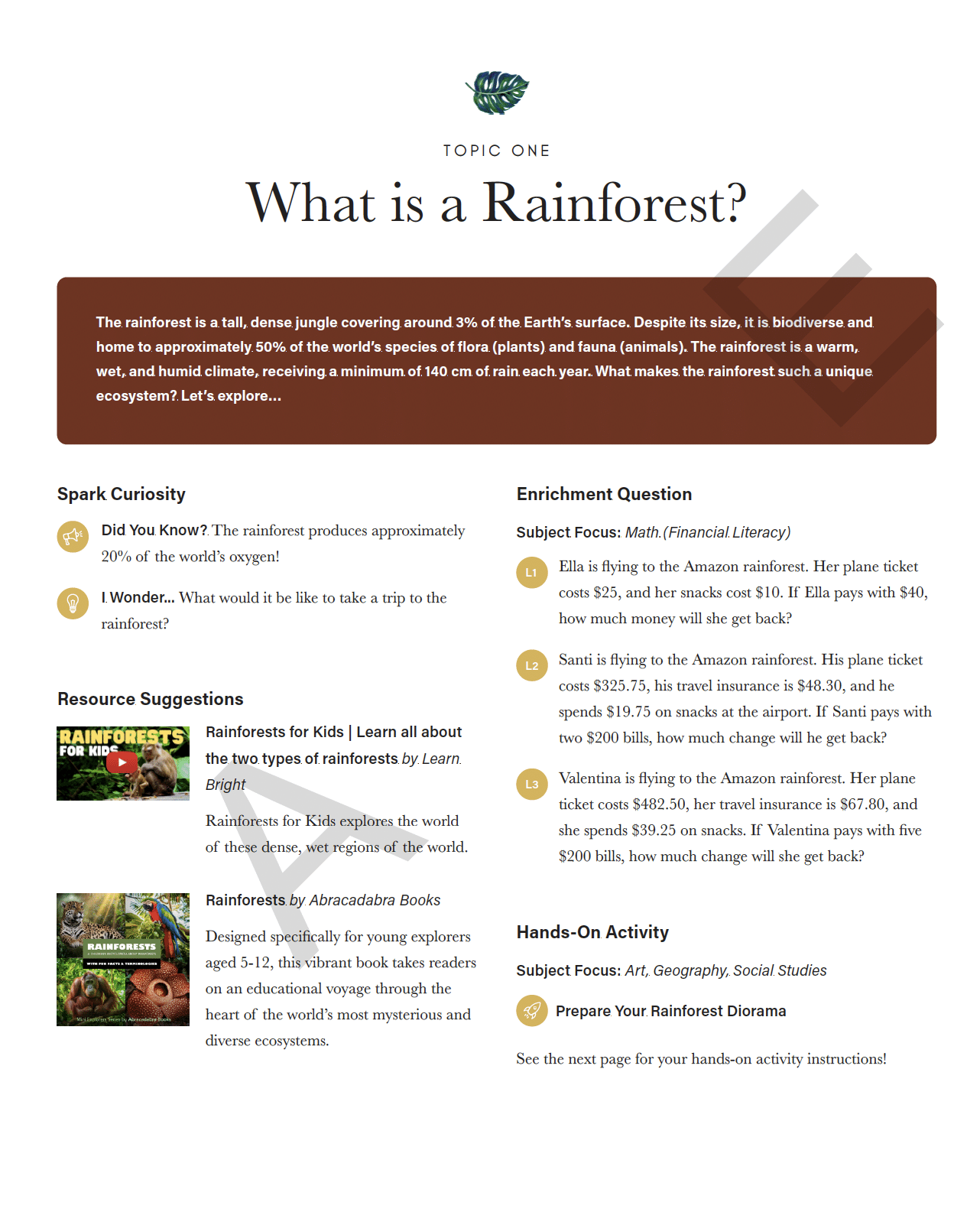
Here are two examples of what most people picture when they hear “unit study”:
Main unit: science themed (cross-curricular) · All subject portions shown below. A fun fact about a rainforest. A cute video. A small book. Three math questions. A diorama.
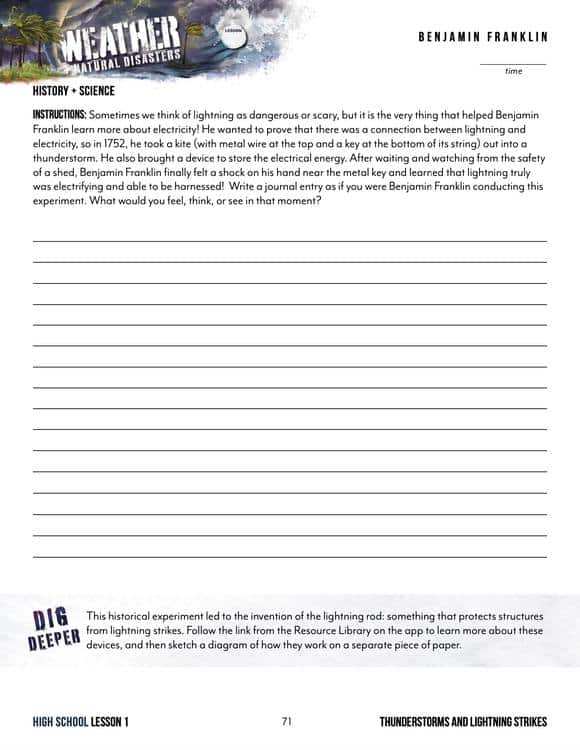
Main unit: science themed (cross-curricular), released 2026· Only the history portion is shown below. It includes a single historical fact about Benjamin Franklin and blank lines. This is the high school history portion for this particular day.
Hover or tap each card to inspect
“…this was one of the most exceptionally done history that I have taught to date. I grew up with a History professor dad, graduated college with a history minor and teach history at our co-op. I know a LOT about history, and I learned so much doing this curriculum this year. Different points of views were expressed and it taught the kids how to be historians. It taught them how to get pieces of information and form opinions, but then hear MORE, thus possibly leading to a change of opinion. It taught them to look at things critically, research and collect more. I was blown away by this curriculum, my kids were entertained, and our side quests from things taught were amazing.”
Main unit: science themed (cross-curricular) released 2025· This is only the history portion for a single lesson (3 of 7 history pages for lesson 1 shown below).
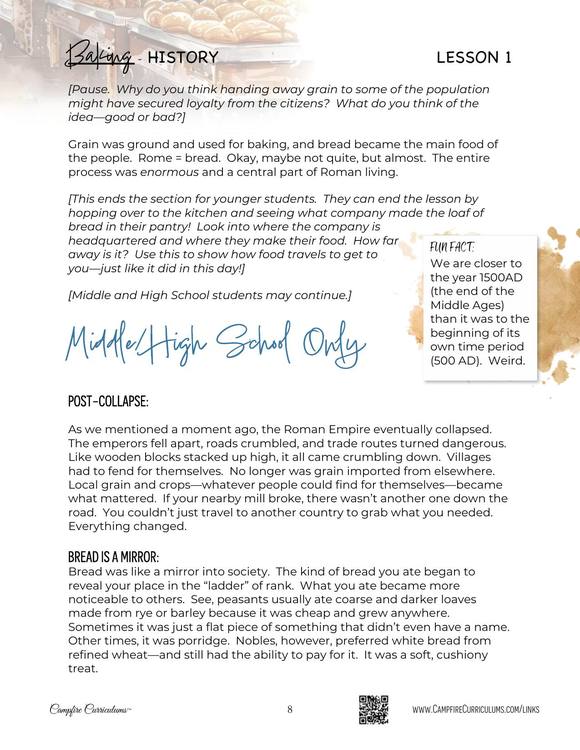
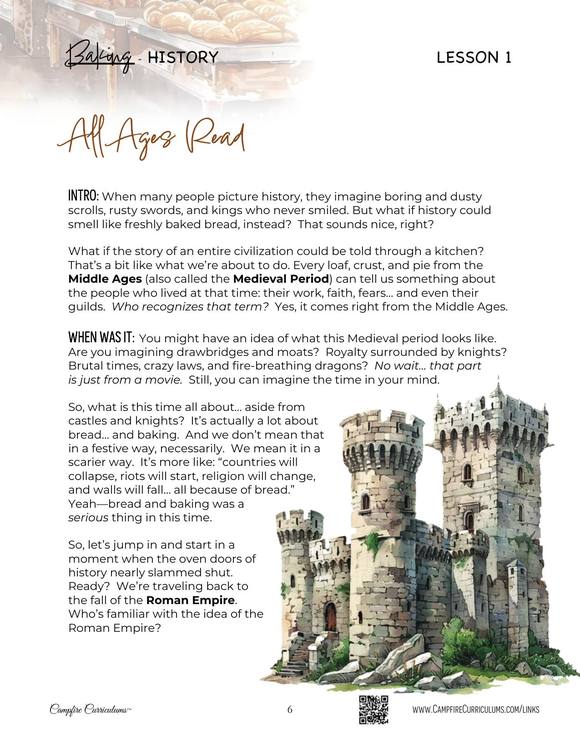
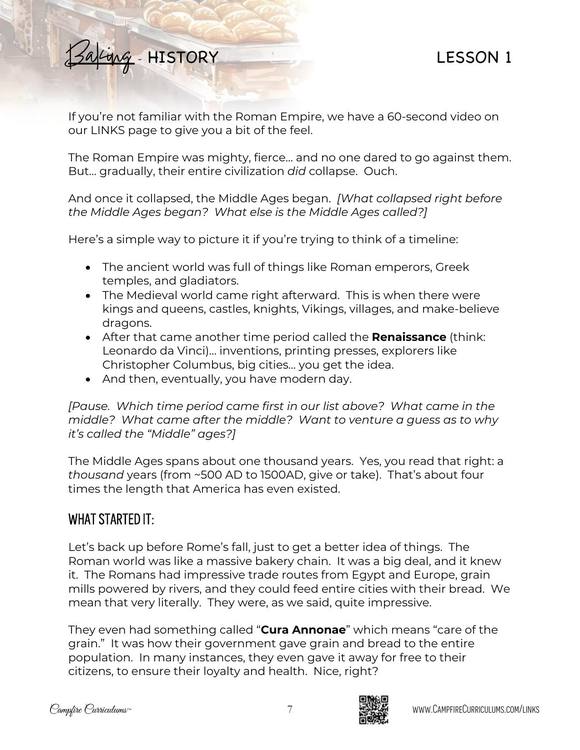
When people compare these as if they are in the same category, it creates confusion… and that’s not even touching on the different teaching philosophies behind each. A multi-disciplinary academic program organized by theme and a “unit study” are fundamentally different things, and the market definition of “unit study” doesn’t fit all of them equally.
Now onto cross-curricular learning… Imagine a high school history teacher spending a month on the Renaissance. The English teacher next door is teaching literature from that same time period. So they decide to combine classes for a few weeks.
Instead of students going to history for 40 minutes and English for 40 minutes, they merge together for one longer class. The history teacher brings the politics, events, culture, and timeline. The English teacher brings the literature, language, worldview, and human experience.
If we split the subjects apart, does that make them more comprehensive?
Of course not.
And if we bring them together intentionally, does that make them less rigorous?
No.
When you remove the stigma and take a closer look, not all themed studies are the same… and it turns out that institutions like Harvard and Yale prefer those who are familiar with and use interdisciplinary learning.
(But what about the sequence? We know… keep reading…)
But What About Science? History? ELA?
Yes, some subjects need sequence.
Science has concepts that build.
History needs a certain kind of chronological connection.
ELA needs consistent practice in reading, writing, grammar, vocabulary, and analysis.
That is why Campfire units are not random.
Each curriculum–even among textbooks–has a different pedagogy and approach. Some go all in with rote memorization. Some focus on quality over quantity. This is true whether you are discussing “textbooks,” “private schools,” “unit studies,” or any other umbrella. If you’re curious where we stand, here are our approaches:
How Campfire Teaches History Differently
Campfire does not teach history as “memorize the textbook and trust the official story.” We put students directly in front of primary and secondary sources (journals, letters, newspapers, speeches, court records, government documents, inquiries, etc.) and teach them how to interrogate the source.
Who said this? Why? What was left out? Who benefits from this version? What conflicts with it? What evidence actually exists or supports the claim?
Our Titanic unit is a great example. We don’t just repeat the widely accepted claims and run with them. We go to the inquiries, look at conflicting data, and challenge assumptions. We spend hundreds of hours researching before putting pen to paper (or—you know—finger to keyboard).
We talk about how the news and media shaped public understanding. And most importantly, we make the larger point: do not blindly trust everything you are told. But also… do weigh the evidence, so that you don’t walk around lost.
We do not treat every theory as equally proven or equally supported. Students can’t go through life trusting everything, trusting nothing, or falling into rumors and traps.
We teach students to ask better questions. “What do you believe about this?” is not enough. We want students asking, “What evidence convinced me? What sources shaped my opinion? Where did those sources come from? What would change my mind?”
That is the heart of how Campfire teaches history: not blind acceptance, cynicism, or just theories, but disciplined discernment.
Critical thinking without agenda.
A note on units that teach history directly (like Independence Day): Campfire does tell the story, but only after weighing primary and secondary sources. We show students the conflicting ideas, present pointed discussion questions, and use primary source activities so they can feel the conflicting data and learn how historians determine what carries more weight. This is done throughout the Boston Massacre, the Boston Tea Party, and more.
We Add What Textbooks Often Leave Out
There is another difference. Our units do not stop at core academic coverage. If you want to learn more about that, head here.
So Is Our Curriculum “Themed Studies”?
Yes.
Are they typical “unit studies” in the way most people mean it? No.
We are an original hybrid model–something that never existed before.
The depth of textbook learning (without the dryness).
The connection of interdisciplinary learning (without the fluff).
The engagement of a unit study (with long-term retention).
The real-world relevance of career and life skills (that your child will have for life).
Connected learning is not a compromise.