


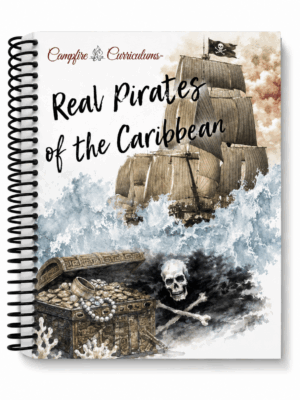


5 Lessons | 1 – 2 weeks | All Ages (K–12) | Single-Subject | No Teacher’s Manual Required
This unit can be combined with Island Life for a full all-in-one learning experience (optional, but really incredible)!
Forget the parrots and eye patches. This isn’t Hollywood. This unit plunges your family into the real world of pirates: the outlaws, the navigators, the strategists, and the surprisingly complex figures who once ruled the seas. You’ll go far beyond the stereotypes as you explore their codes of conduct, ship mechanics, impact on global trade, and clashes with maritime law.
Students study ship mechanics, navigation systems, trade routes, and the economic pressures that fueled the Golden Age of Piracy. They examine slavery, naval warfare, maritime law, and the geopolitical tensions that shaped entire regions.
Older students simulate historic navigation techniques, practice spatial reasoning with map work and compass use, and analyze pirate codes of conduct through a cultural and ethical lens.
Was piracy chaos… or just an alternative social system? Was there loyalty among thieves? What drives rebellion?
Every lesson builds directly on the page with discussion, analysis, and writing together in one structured experience.
It’s high-stakes history and geography in motion.
By the end, students will know more than pirate lore.
Part history, part survival, part strategy… this unit invites you to see the world through the eyes of those who navigated its edges.
High school families may document this unit as shown on the course coverage/transcript/credit tabs above.
This is a Mini Unit, designed for the whole family to use together, whether you have one student or many. It includes 5 flexible lessons, typically stretched over 2 – 4 weeks (depending on your pace).
Most families complete 6–8 full units per year. Think of one unit like a single “chapter” in a year-long curriculum.
This isn’t one-lesson-per-day curriculum. Each lesson may span multiple days. You set the rhythm.
Every unit is delivered as a PDF digital download, so you can start instantly. Prefer a printed book? You can get that, too! Want to understand all your print options? Flip to the “Print or Digital” page in our BROCHURE for a full breakdown of how to access print copies.
There are three digital guidebooks:
- Early Learner Guidebook (pre-reader to 1st grade) – Designed to keep little hands busy and minds engaged while older students go deeper.
- Growing Guidebook (elementary through middle school)
- Advanced Guidebook (high school to adult)
The Growing and Advanced Guidebooks share the same main lesson content. The difference is in the sidebars—color-coded and tailored by age. Think of it like reading the same Bible translation, but one has deep apologetics notes and the other has gentle prompts and kid-friendly commentary. Same core text, just age-adjusted insight.
This is intentionally designed to mimic higher-level education and real-world learning. You won’t find a separate teacher’s manual or student workbook because we don’t believe in busywork. Instead, each guidebook is written directly to the student (and the parent learning alongside) with real instruction, interactive prompts, and a flow that mirrors real-life, higher-level learning.
You’ll see natural cues like “Do this now,” “Write this in your notebook,” and “Pause to discuss,” built right into the lesson. Students learn through notebooking, narration, dictation, and hands-on exploration—no pre-planning required. It might feel different at first. That’s because it is… and it’s intentional.
There is no Core Connections Companion.
Campfire encourages students to think deeply, not just check boxes. That means we don’t ask for rote answers; we ask for reflection, connection, and real understanding. For students used to worksheet-style learning, this can come as a shift. You might notice a transition phase as their brain adjusts to a higher level of engagement, and that’s part of the growth.
Some younger learners (especially ages 6–8) may need extra support or time. It depends on the child. If your student is used to rich read-alouds and open discussion, they may jump right in. Others might benefit from starting with just the Early Learner Guidebook or waiting for Campfire until they’re ready for more independent thinking.
We’ve seen some 7-year-olds fall in love with it. Others needed to wait until 9 to tackle everything comfortably. You know your child best, and this curriculum gives you the freedom to meet them right where they are.









Campfire Curriculums (verified owner) –
Reviews