50 States – Midwest & Great Plains (Digital)

Flexible unit i
Science, US History, SS, ELA, Geography, Ethics, Economics, Bible

$32.00

- +
Researched in real communities and culture.

Built from immersive, on-the-ground interviews with local communities, bringing real-world perspectives and lived experiences into every unit.

Campfire Method™
  • 4 levels in 1, covering elementary - college prep (see "What is Included" button below)
  • No printing required unless desired (screencast or print). Format: PDF.
Works Alone or as Part of the 50 States Series Explore the full series →

What This Unit Is About

12 Lessons | ~4 weeks | All Ages (K–12) | Multi-Subject | No Teacher’s Manual Required 
This can be used as a standalone or combined with other units in the series.  There are also free samples available at the series link.

North Dakota, South Dakota, Nebraska, Kansas, Missouri, and Iowa

This is the American heartland like you’ve never seen it, where outlaw shootouts, earth-shaping winds, ancestral burial mounds, and the invention of a digital computer all exist in the same story. This Midwest/Great Plains unit takes your family into one of the most misunderstood and underestimated regions in the country. This isn’t only about cornfields and cows (though they’re here, too). It’s about invention, survival, legacy, and complexity… brought together in unforgettable lessons.

You’ll dive into:

  • The true story of Kate Shelley, a teenage girl who went down in history

  • The Loess Hills, formed by wind, found only here and in China

  • Forgotten Native cities and ancient effigy mounds

  • Environmental concerns like pesticide runoff and radon-linked cancer rates

Your students will be challenged to evaluate bias, historical fairness, and ethics. They’ll be challenged with:

  • Who really owned the land during westward expansion?

  • How does biased writing shape historical interpretation?

  • What does it mean to think critically across generations?

This unit blends:

  • The scientific marvel of prairie potholes and glacial impact

  • Ethical questions and bias surrounding topics like land seizure, treaty manipulation, and Native or European hostility

  • The cultural brilliance of things like ham balls… and wrestling

  • Wild tales like the lost Bonnie & Clyde loot and Iowa’s “Field of Dreams” in a cornfield

    Immersive activities like building a sod house, designing pollution-filtering inventions, and recreating historical recipes (Snickers salad), are in every lesson pulling students into the story and keeping them there.

This is where America grew its roots.

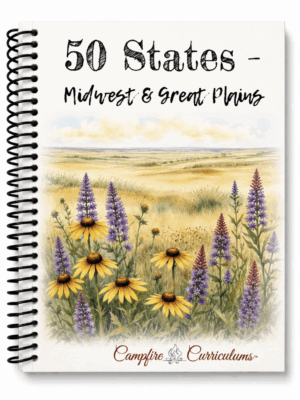
***The covers shown here are for display purposes only, to help customers distinguish between regions. This is one of many units in our Geography Series and will be delivered with the standard Geography Series cover.***

What Kind of Unit Is This

This is an Extra Large Mini Unit, designed for the whole family to use together, whether you have one student or many. It includes 12 flexible lessons, typically stretched over 4–6 weeks (depending on your pace).

Most families complete 6–8 units per year. Think of one unit like a single “chapter” in a year-long curriculum.

This isn’t one-lesson-per-day curriculum. Each lesson may span multiple days. You set the rhythm.

Print or PDF?

Every unit is delivered as a PDF digital download, so you can start instantly. Prefer a printed book? You can get that, too! Want to understand all your print options? Flip to the “Print or Digital” page in our BROCHURE for a full breakdown of how to access print copies.

What You’ll Receive
  • Growing + Advanced Combo Guidebook (pre-reader through adult) – Some of our units include a Combo Guidebook, which merges the Growing and Advanced versions into one seamless file. It’s easier for families to use (less to manage, same amount of content). Don’t worry; nothing’s missing. The price is the same because the content is the same… just organized more efficiently.

The difference is in the sidebars—color-coded font is for older students only.

What Is Not Included

This is intentionally designed to mimic higher-level education and real-world learning. You won’t find a separate teacher’s manual or student workbook because we don’t believe in busywork. Instead, each guidebook is written directly to the student (and the parent learning alongside) with real instruction, interactive prompts, and a flow that mirrors real-life, higher-level learning.

You’ll see natural cues like “Do this now,” “Write this in your notebook,” and “Pause to discuss,” built right into the lesson. Students learn through notebooking, narration, dictation, and hands-on exploration—no pre-planning required. It might feel different at first. That’s because it is… and it’s intentional.

Core Connections

There is no Core Connections Companion.  There is, however, sufficient activity extensions and suggestions to easily use this as an all-in-one if desired.

LINKS Page + Audio Add-Ons

Each unit includes access to our private LINKS page with videos, supply lists, book lists, and bonus resources—everything pre-screened and organized for easy use. Some units also have optional MP3 add-ons for auditory learners.
1 review for 50 States – Midwest & Great Plains (Digital)

  1. Campfire Curriculums –

    Reviews

Only logged in customers who have purchased this product may leave a review.

Geography & Regional Studies:

This unit focuses on the Great Plains portion of the Midwest, covering the states North Dakota, South Dakota, Nebraska, Kansas, Missouri, and Iowa. Students explore the flatlands, prairie biomes, and vast agricultural landscapes of this region. Lessons include study of landforms, water systems, regional resources, and the impact of climate on lifestyle and economy. Students develop map-reading and spatial reasoning skills while connecting physical geography with human settlement patterns.

Language Arts (Reading Comprehension & Composition):

Assignments include descriptive writing, journaling, and informational synthesis that explore regional identity and landscape. Students may practice grammar, paragraph development, and research integration, using prompts tied to geography, culture, and personal reflection.

History (Homesteading, Native Tribes & Agricultural Shifts):

Students examine the historic role of the Great Plains in westward expansion, Native American influence, railroads, homesteading, and the development of large-scale agriculture. Topics include the Dust Bowl, cattle drives, railroads, and how federal policies shaped the Plains. The unit highlights resilience, migration, and innovation.

Cultural Anthropology & Sociology:

Through the study of rural life, frontier values, and modern farming communities, students gain insight into how cultural identity has evolved across the Plains. The curriculum highlights how economic forces, tradition, and environmental conditions influence family structure, social norms, and community development.

Science (Agricultural Ecology & Meteorology):

Students explore soil science, crop systems, and extreme weather patterns such as tornadoes and drought. The curriculum supports understanding of human interaction with natural resources and modern sustainability practices. Optional projects include weather journaling and ecosystem studies of prairie regions.

Ethics & Philosophy (Optional Integration):

This unit encourages students to reflect on land stewardship, agricultural responsibility, and the moral implications of displacement and resource use. Students explore themes of ownership, community resilience, and humanity’s role in sustaining natural ecosystems.

Economics (Agricultural Systems & Land Resource Management):

Students explore the economic structure of the Great Plains through its dependence on large-scale agriculture, such as wheat, corn, and cattle industries. The curriculum discusses how flat terrain and expansive land shaped mechanized farming, crop distribution, and state-level economic identity. Students also consider how environmental features like tornadoes, drought, and soil type affect resilience and risk, encouraging awareness of both opportunity and vulnerability in resource-based economies.

Economics (Mining, Tourism & Land-Based Trade):

Students examine how the mountainous terrain of the Rockies influenced economic development through mining, tourism, and ranching. The curriculum includes references to gold and silver rushes, railroad development, and the rise of small-town economies centered around natural resources.

Subject Area Credit Breakdown

  • Geography (Great Plains Regional Studies):1/4 to 1/2 credit
  • History (Homesteading & Agricultural History):1/6 credit
  • Economics: 1/6 credit
  • English Language Arts (Descriptive & Informative Writing):1/6 credit
  • Science (Agricultural Science & Weather Systems):1/6 credit
  • Ethics & Philosophy (Optional):1/6 credit
  • Extracurricular (Choose one: Travel Studies, Cultural Anthropology, or Environmental Field Science):1/6 to 1/2 credit

Select Wishlist

50 States - Midwest & Great Plains (Digital)50 States – Midwest & Great Plains (Digital)
$32.00
- +
Researched in real communities and culture.

Built from immersive, on-the-ground interviews with local communities, bringing real-world perspectives and lived experiences into every unit.

Campfire Method™
Scroll to Top