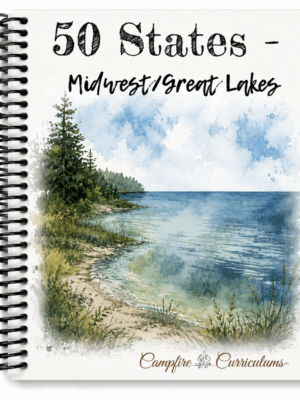
50 States – Midwest/ Great Lakes (Digital)

Flexible unit i
Science, US History, SS, ELA, Geography, Ethics, Economics, Bible

$32.00

- +
Researched in real communities and culture.

Built from immersive, on-the-ground interviews with local communities, bringing real-world perspectives and lived experiences into every unit.

Campfire Method™
  • 4 levels in 1, covering elementary - college prep (see "What is Included" button below)
  • No printing required unless desired (screencast or print). Format: PDF.
Works Alone or as Part of the 50 States Series Explore the full series →

What This Unit Is About

12 Lessons | ~4 weeks | All Ages (K–12) | Multi-Subject | No Teacher’s Manual Required 
Minnesota, Wisconsin, Illinois, Indiana, Michigan, and Ohio

This can be used as a standalone or combined with other units in the series.  There are also free samples available at the series link.

The Rust Belt Roars to Life

In this unit, your family will walk through the rise and collapse of America’s steel empire. Coal veins and ghost cities (of post-industrial decline) make this unit with economic history personal and inspiring. It covers:

  • The burning of the Cuyahoga River (and the birth of the EPA)

  • The birth of unions, and how they shaped cities and policy

  • What a “glaciated plain” really looks like, and how it formed

Up for debating who was the first in flight or baking some buckeye cookies?  How about taking a virtual ghost tour of Mansfield Reformatory, analyzing how Midwest cities impact surrounding states, or investigating how immigration shaped entire culinary and linguistic landscapes?

Also included:

  • New England colonial remnants in northern Ohio

  • German and Amish legacies still defining entire regions

  • Urban sprawl vs. farm life, seen side by side

  • Real and funny stories, like the settlers who forgot to finish statehood paperwork for 150 years


***The covers shown here are for display purposes only, to help customers distinguish between regions. This is one of many units in our Geography Series and will be delivered with the standard Geography Series cover.***

What Kind of Unit Is This

This is an Extra Large Mini Unit, designed for the whole family to use together, whether you have one student or many. It includes 12 flexible lessons, typically stretched over 4–6 weeks (depending on your pace).

Most families complete 6–8 units per year. Think of one unit like a single “chapter” in a year-long curriculum.

This isn’t one-lesson-per-day curriculum. Each lesson may span multiple days. You set the rhythm.

Print or PDF?

Every unit is delivered as a PDF digital download, so you can start instantly. Prefer a printed book? You can get that, too! Want to understand all your print options? Flip to the “Print or Digital” page in our BROCHURE for a full breakdown of how to access print copies.

What You’ll Receive
  • Growing + Advanced Combo Guidebook (pre-reader through adult) – Some of our units include a Combo Guidebook, which merges the Growing and Advanced versions into one seamless file. It’s easier for families to use (less to manage, same amount of content). Don’t worry; nothing’s missing. The price is the same because the content is the same… just organized more efficiently.

The difference is in the sidebars—color-coded font is for older students only.

What Is Not Included

This is intentionally designed to mimic higher-level education and real-world learning. You won’t find a separate teacher’s manual or student workbook because we don’t believe in busywork. Instead, each guidebook is written directly to the student (and the parent learning alongside) with real instruction, interactive prompts, and a flow that mirrors real-life, higher-level learning.

You’ll see natural cues like “Do this now,” “Write this in your notebook,” and “Pause to discuss,” built right into the lesson. Students learn through notebooking, narration, dictation, and hands-on exploration—no pre-planning required. It might feel different at first. That’s because it is… and it’s intentional.

Core Connections

There is no Core Connections Companion.  There is, however, sufficient activity extensions and suggestions to easily use this as an all-in-one if desired.

LINKS Page + Audio Add-Ons

Each unit includes access to our private LINKS page with videos, supply lists, book lists, and bonus resources—everything pre-screened and organized for easy use. Some units also have optional MP3 add-ons for auditory learners.
1 review for 50 States – Midwest/ Great Lakes (Digital)

  1. Campfire Curriculums –

    Reviews

Only logged in customers who have purchased this product may leave a review.

Geography & Regional Studies:

This unit focuses on the Great Lakes states—Minnesota, Wisconsin, Illinois, Indiana, Michigan, and Ohio—introducing students to freshwater geography, glacial landforms, prairies, and major urban centers. Lessons guide students in map work, understanding lake-effect weather, and analyzing the economic and cultural importance of the Great Lakes region. Human-environment interaction is explored through agriculture, manufacturing, and environmental conservation.

Language Arts (Reading Comprehension & Composition):

Assignments include place-based writing, personal reflections, and summaries that help students synthesize geographical and historical content. Additional writing assignments relating to any activity may develop grammar accuracy, and voice, encouraging both creative and academic expression through regional themes.

History (Industrialization, Native Lands & Migration):

Students examine the historical transformation of the Midwest, from indigenous territories and frontier life to industrial expansion and modern urbanization. The unit includes discussion of immigration, labor history, and regional contributions to U.S. innovation and culture.

Cultural Anthropology & Sociology:

Students study the Midwest’s role as America’s “heartland,” including its values, dialects, food traditions, and rural-urban dynamics. They analyze how cultural identity is shaped by geography, migration, and economics, and explore how Midwestern communities reflect both diversity and cohesion.

Science (Freshwater Systems & Climate):

Environmental lessons center on freshwater ecology, glacial history, and Great Lakes weather systems. Topics include water quality, lake stratification, invasive species, and sustainability efforts. Field journaling or local lake studies may enhance observation and scientific writing skills.

Ethics & Philosophy (Optional Integration):

Students reflect on environmental responsibility, the ethics of resource use, and historical justice in relation to displaced indigenous communities.


Economics (Manufacturing, Trade, and Waterway Industry):

Students explore the economic importance of the Great Lakes, highlight the historical significance of the auto industry in Michigan, the steel industry, and how lake access transformed cities like Chicago and Detroit into economic powerhouses. The unit also touches on resource-based economies and infrastructure, like bridges, canals, and shipping routes, that shaped the region’s growth and identity.


  • Geography (Midwest & Great Lakes Regional Studies):1/4 to 1/2 credit
  • History (Industrial, Indigenous & Migratory History):1/6 credit
  • Economics: 1/6 credit
  • English Language Arts (Research & Narrative Writing):1/6 credit
  • Science (Freshwater & Climate Science):1/6 credit
  • Ethics & Philosophy (Optional):1/6 credit
  • Extracurricular (Choose one: Travel Studies, Cultural Anthropology, or Environmental Field Science):1/6 to 1/2 credit

Select Wishlist

50 States - Midwest/ Great Lakes (Digital)50 States – Midwest/ Great Lakes (Digital)
$32.00
- +
Researched in real communities and culture.

Built from immersive, on-the-ground interviews with local communities, bringing real-world perspectives and lived experiences into every unit.

Campfire Method™
Scroll to Top