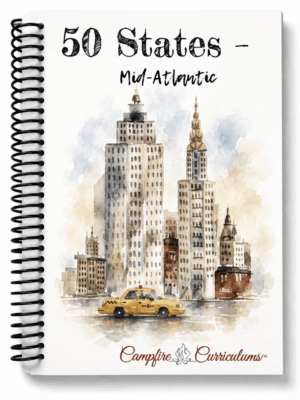
50 States – Mid Atlantic (Digital)

Flexible unit i
Science, US History, SS, ELA, Geography, Ethics, Economics, Bible

$32.00

- +
Researched in real communities and culture.

Built from immersive, on-the-ground interviews with local communities, bringing real-world perspectives and lived experiences into every unit.

Campfire Method™
  • 4 levels in 1, covering elementary - college prep (see "What is Included" button below)
  • No printing required unless desired (screencast or print). Format: PDF.
Works Alone or as Part of the 50 States Series Explore the full series →

What This Unit Is About

11 Lessons | ~4 weeks | All Ages (K–12) | Multi-Subject | No Teacher’s Manual Required 
This can be used as a standalone or combined with other units in the series.  There are also free samples available at the series link.

New York, New Jersey, Pennsylvania, Delaware, Maryland, DC

What other geography unit takes you from eating authentic New York pizza with a mysterious character in Grand Central Station to exploring the eerie legends of Henry Hudson’s ghost ship near Sleepy Hollow?

Only this one. …And that’s just New York.  You travel through many other states after that.

This unit isn’t a bullet-point list of trivia. It brings the region to life with:

  • A fully immersive storyline that continues from the New England unit (you can save the storyline for the end of the series, so no need to do these in order)

  • Layered culture contrasts that make students want to experience it

  • Events rarely taught in school, like the violent 1863 NYC Draft Riots, presented with storytelling depth

Every page is built for multi-sensory learning:

  • Knead dough for authentic NYC soft pretzels

  • Debate historical ethics in “Think Tank”

  • Explore cultural identity through street vendors, subways, and farm towns

  • Learn science through hydroelectric power

This unit builds:

  • Character through humility vs. pride discussions (Faith Talk)

  • Perspective through economic and racial tension

  • Geographical mastery through hands-on mapping

  • Literary skill through writing, storytelling, and vivid language

Don’t just teach the Mid-Atlantic states; let your students live them!

You’ll be lighting a fire for learning that stretches from the Statue of Liberty to far beyond the Adirondack peaks.

***The covers shown here are for display purposes only, to help customers distinguish between regions. This is one of many units in our Geography Series and will be delivered with the standard Geography Series cover.***

What Kind of Unit Is This

This is an Extra Large Mini Unit, designed for the whole family to use together, whether you have one student or many. It includes 11 flexible lessons, typically stretched over ~4 weeks (depending on your pace).

Most families complete 6–8 units per year. Think of one unit like a single “chapter” in a year-long curriculum.

This isn’t one-lesson-per-day curriculum. Each lesson may span multiple days. You set the rhythm.

Print or PDF?

Every unit is delivered as a PDF digital download, so you can start instantly. Prefer a printed book? You can get that, too! Want to understand all your print options? Flip to the “Print or Digital” page in our BROCHURE for a full breakdown of how to access print copies.

What You’ll Receive
  • Growing + Advanced Combo Guidebook (pre-reader through adult) – Some of our units include a Combo Guidebook, which merges the Growing and Advanced versions into one seamless file. It’s easier for families to use (less to manage, same amount of content). Don’t worry; nothing’s missing. The price is the same because the content is the same… just organized more efficiently.

The difference is in the sidebars—color-coded font is for older students only.

What Is Not Included

This is intentionally designed to mimic higher-level education and real-world learning. You won’t find a separate teacher’s manual or student workbook because we don’t believe in busywork. Instead, each guidebook is written directly to the student (and the parent learning alongside) with real instruction, interactive prompts, and a flow that mirrors real-life, higher-level learning.

You’ll see natural cues like “Do this now,” “Write this in your notebook,” and “Pause to discuss,” built right into the lesson. Students learn through notebooking, narration, dictation, and hands-on exploration—no pre-planning required. It might feel different at first. That’s because it is… and it’s intentional.

Core Connections

There is no Core Connections Companion.  There is, however, sufficient activity extensions and suggestions to easily use this as an all-in-one if desired.

LINKS Page + Audio Add-Ons

Each unit includes access to our private LINKS page with videos, supply lists, book lists, and bonus resources—everything pre-screened and organized for easy use. Some units also have optional MP3 add-ons for auditory learners.
1 review for 50 States – Mid Atlantic (Digital)

  1. Campfire Curriculums –

    Reviews

Only logged in customers who have purchased this product may leave a review.

Geography & Regional Studies:

This unit explores the Mid-Atlantic region of the United States, including New York, New Jersey, Pennsylvania, Delaware, and Maryland. Students study the geographical diversity of the region, from coastal plains and major rivers to urban centers and rural farmlands. The curriculum strengthens skills in cartography, spatial analysis, and thematic mapping while helping students understand how geography shapes commerce, culture, and daily life.

Language Arts (Reading Comprehension & Composition):

Students engage with reflective journaling, descriptive writing, and historical storytelling to enhance comprehension and expressive skills. Writing prompts encourage exploration of personal connections to places visited or studied. Assignments promote grammar fluency, structure, and stylistic development, tailored for upper middle and high school levels.

History (Colonial Roots, Industrialization & Urban History):

Students trace the colonial and industrial past of the Mid-Atlantic region, including early settlements, Dutch and Quaker influences, immigration, and urban development. Lessons highlight the region’s significance in the founding of the United States, growth of major cities like New York and Philadelphia, and the transportation networks that fueled economic expansion.

Cultural Anthropology & Sociology:

The unit examines social dynamics, immigrant contributions, and the formation of regional identity. Students consider the melting pot nature of the Mid-Atlantic states and explore cultural expressions, religious diversity, and the impact of urbanization. Comparative analysis helps learners understand cultural continuities and transformations over time.

Science (Environmental Studies & Urban Ecology):

Environmental lessons focus on the region’s waterways, ecosystems, and conservation efforts. Students investigate pollution, land use, biodiversity, and the ecological challenges of densely populated areas. Optional outdoor or documentary-based observations support understanding of local flora, fauna, and environmental stewardship.

Ethics & Philosophy:

Students reflect on ethical questions related to urban growth, historical displacement, and stewardship of natural resources. Topics may include civic responsibility, environmental justice, and the philosophical implications of regional legacy and change.

Economics (Commerce, Trade Routes & Industrial Impact):

Students examine how geography shaped economic development in the Mid-Atlantic, focusing on coastal commerce, agriculture, coal mining, and urban growth. Through the “bane and boon” framework, learners assess both the benefits and drawbacks of regional industries—such as the prosperity from mining and the environmental or social costs that accompany it. Real-world examples like crabbing in Chesapeake Bay and the Erie Canal foster understanding of how innovation can carry both promise and consequence.


Civics (Founding Principles, Justice, and Community Reflection):

This unit highlights the Mid-Atlantic’s role in the birth of American democracy, including the Declaration of Independence and the Constitution. Through historical narratives and modern reflection, students explore civic themes like liberty, justice, and leadership. The “bane and boon” discussions extend into civic responsibility—encouraging students to weigh the ethical implications of progress, lawmaking, and leadership decisions on communities and future generations.

Subject Area Credit Breakdown

  • Geography (Mid-Atlantic Regional Studies): up to 1/4 credit
  • History (Colonial, Urban & Industrial U.S. History): 1/6 credit
  • Economics: 1/6 credit
  • English Language Arts (Regional Descriptive Writing & Composition): 1/6 credit
  • Science (Environmental & Urban Ecology): 1/6 credit
  • Ethics & Philosophy (Optional): 1/6 credit
  • Extracurricular (Choose one: Travel Studies, Cultural Anthropology, or Urban Field Science): up to 1/4 credit

Extracurricular Option:

Travel Studies, Cultural Anthropology, or Urban Field Science depending on time spent, depth of journaling, and any added projects.

  • Travel Studies: Students explore regional variation through simulated or real visits, documenting their findings.
  • Cultural Anthropology: Emphasizes cultural development, immigration, and city-based traditions across Mid-Atlantic communities.
  • Urban Field Science: Focuses on ecosystems, pollution, and sustainability in urban and suburban settings, with field or observational opportunities.

Select Wishlist

50 States - Mid Atlantic (Digital)50 States – Mid Atlantic (Digital)
$32.00
- +
Researched in real communities and culture.

Built from immersive, on-the-ground interviews with local communities, bringing real-world perspectives and lived experiences into every unit.

Campfire Method™
Scroll to Top